James Benning Pays with Time
In Conversation with James Benning
by Juliet Belisario
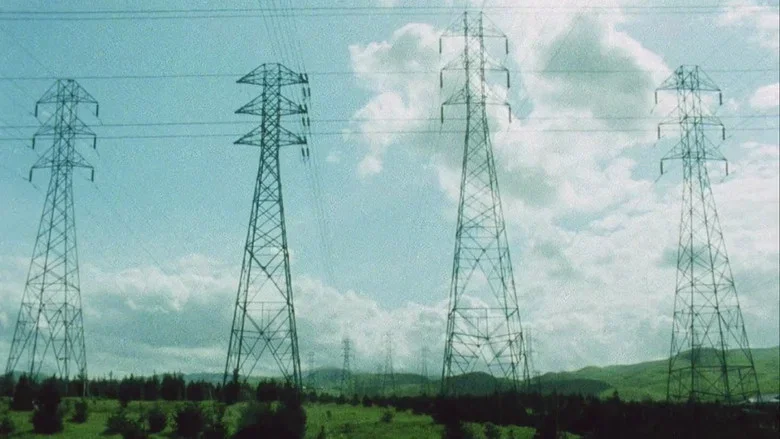
Landscape Suicide. 1986. Dir. James Benning.
Interview Date: July 30, 2026-October 12, 2026. Publication Date: November 15, 2026. Via email.
This conversation has been edited and condensed for clarity.
James Benning is an American experimental filmmaker and a leading figure in structuralist and minimalist cinema. Originally from Milwaukee, Wisconsin, he has been making films since 1972, and teaching film at CalArts since 1987. Working first in 16mm and later in digital video, he often holds the camera still for minutes at a time, asking viewers to look and listen closely to the American landscape. He has won top prizes at Cinéma du Réel and IndieLisboa, and his work has been featured in multiple Whitney Biennials alongside retrospectives at institutions like MoMA and the Centre Pompidou. His notable films include 11 x 14 (1976), Landscape Suicide (1986), and the California Trilogy (1999–2001).
Like his films, James Benning is patient. We corresponded by email over four months while he was teaching at CalArts and editing his two latest features, Hwy 1 and Eden, which he plans to release as a double feature. Through our sustained exchange, we discuss all ranging from the childhood memory that taught James to look and listen, and what he felt when he watched footage of the Bear River Massacre site on his Steenbeck. He also tells me of his correspondence with Ted Kaczynski and the work of maintaining the replicas he built of Kaczynski’s and Henry David Thoreau’s cabins. He also recalls standing alone on a gravel road watching a solar eclipse, and the Leonard Cohen song that came to mind a momentarily after the daylight returned.
Your films often ask us to spend a long time with a single image. For you, what’s the difference between looking and actually seeing? What changes after the first minute or two of watching a landscape?
For this question, I’d like to go back in time. When I was 10 or 12, my uncle would take my brother and me and his adopted son on outings. Mostly to some place not so far away in miles, but far away in experience. On the way there, he would sing in the car. Silly songs like the one about a billboard damaged by a storm. And what remained on that billboard would make you laugh and cry. “Come smoke a Coca-Cola, chew catsup cigarettes.” And then we would walk in the woods and he’d make us pay attention. It was from these trips that I learned to look and listen. And it was from these trips that I learned what could be learned by doing so.
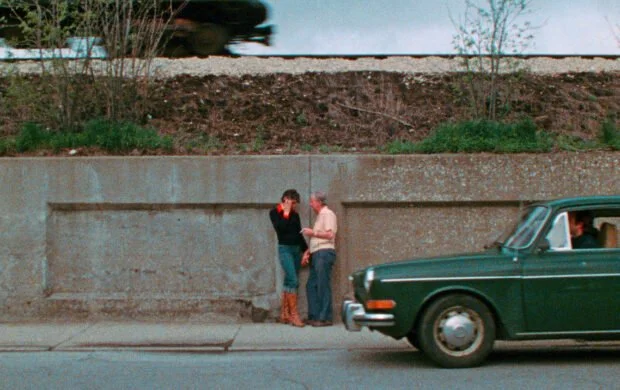
11×14. 1977. Dir. James Benning
People often describe your films as being about landscapes, but they also contain memory and history. I’m reminded of Agnès Varda’s line in The Beaches of Agnès (2008): “If you opened people up, you’d find landscapes.” Do you think a landscape can be a kind of self-portrait?
Certainly, history is written across the land, and the land becomes a portrait of what’s passed over it. William Least Heat-Moon’s PrairyErth (1991, Book), is a testament to that. But yes, if one looks close enough and pays with time, the experience can add to one’s own being. So we don’t just affect the landscape; it also affects us. Unfortunately, land has been seen more as an investment or commodity than as a teacher. But if I consider the whole history of the Earth, what it teaches is impossible for me to comprehend.
If history is written across the land, how do you begin to read it? When you’re deciding where to place your camera, what tells you that a place still carries a history of violence, even when there’s little visible trace of it?
I believe I mostly make a shot first from an aesthetic point of view. I might go to a particular place because I’m aware of a history that passed through, but I then look carefully to frame that history aesthetically. I find this technique to render history in a strong and powerful way. But I must be clear that I’m not talking about beauty; I’m talking about the strength of an image. Years ago, when filming Deseret (1996), I went to the Idaho border to film the site of the Bear River Massacre. The land was barren, and a blizzard was coming down from the north. When I put the work print onto my Steenbeck, I could feel the mass murder that took place there. I really can’t tell you why.
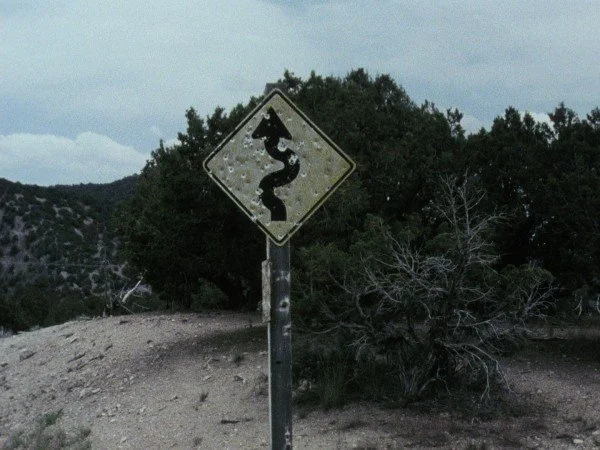
Desert, 1996. Dir. James Benning
You mentioned putting the work print of Deseret on your Steenbeck. Is there anything you miss about cutting 16mm by hand? Did working on a Steenbeck shape the way you edit digitally?
Working in film made me think before I’d act. Film stock is expensive. My shooting ratio in 16mm was less than 2 to 1. Film made me plan. And I take this way of working into the digital world. But I find working digitally is far superior, especially with editing and image control. I can now color correct, reframe, blow up, and collage an image while sitting at my computer. And I can try several cuts without worrying about destroying my work print. There really is no comparison. And I don’t miss the physicalness of splicing film together, the loss of touch. I have enough physical work keeping my two cabins maintained. I must also add that I like the look of HD digital footage better than film. It’s less romantic. And I like HD better than 4K and beyond. Those mediums render an image too defined. But this isn’t right or wrong; it’s a matter of taste.
Those two cabins are replicas of Henry David Thoreau’s and Ted Kaczynski’s. What drew you to those two in particular? What do they mean to you now that you’ve spent close to twenty years living alongside them and looking after them?
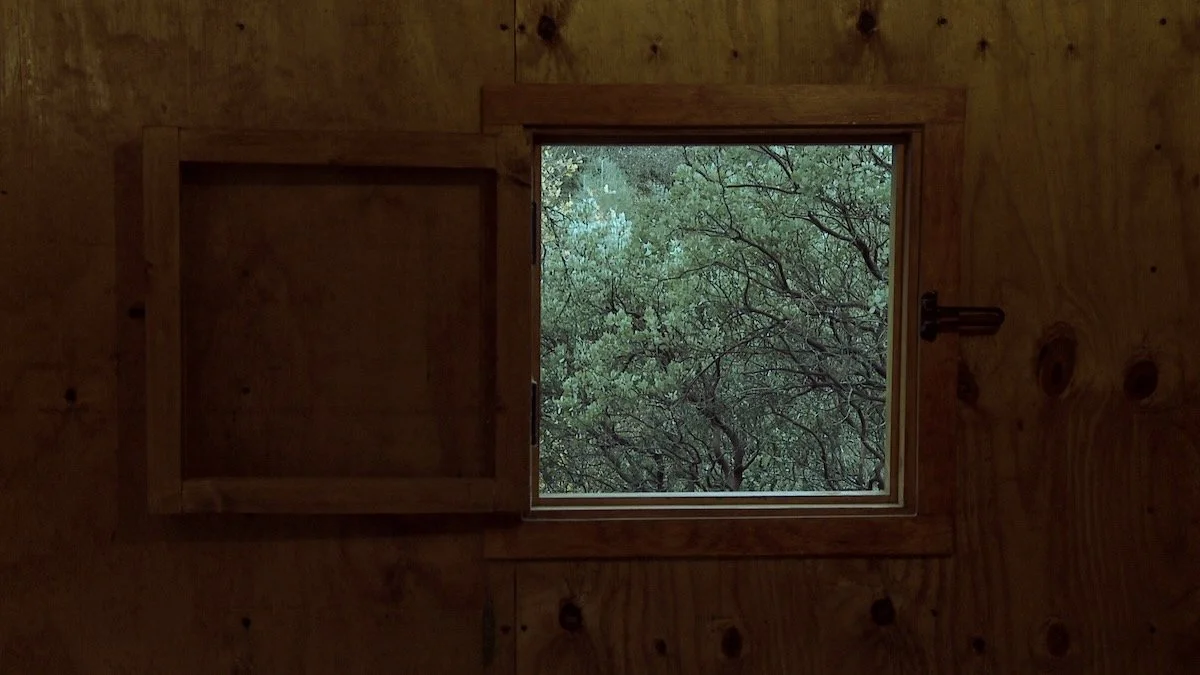
25 years ago I bought property in Pine Flat, California, that included a small house. It was in perfect condition, but I wanted to make it my own, so I tore the place apart and put it back together. I added a room in the basement and improved the interior. That took about 9 months. I bought the place because it was quiet and had an amazing view of the surrounding mountains. I wanted a studio where I could hide away. When I finished the remodelling, I began to teach myself to paint by copying several outsider artists I was fond of. After a few years, I decided to build a house by myself. But since I was in my 60s at the time, I realized a small house would be best. Thoreau’s cabin came immediately to mind. It took me six weeks to prepare the foundation and nine months to complete the construction. When I finished, I hung a few of my paintings inside, and the cabin and paintings began to speak to each other. I realized all of this was becoming art. Over that winter, I decided this newly found art needed a counterpoint, something that would bring it to life. Similar to when I added Arthur Bremer’s diary to my film American Dreams (Lost and Found) (1984). So, in the spring I began to build a second cabin, a copy of Kaczynski’s, the Unabomber. The two cabins have become perhaps my strongest work. A book with Julie Ault followed, and several films: Two Cabins (2011), Nightfall (2012), Stemple Pass (2012), Data Entry (2014), and Concord Woods (2014). This led to my first solo museum show, curated by Peter Pakesch at Kunsthaus Graz in Austria. Now, some 20 years later, the cabins need yearly attention. This spring I had to replace the roofing on the Kaczynski cabin. Ted used rather cheap materials, and I followed his lead. Two of my graduate students helped me. It took me almost a month to locate the proper material. Occasionally, friends sleep in the cabins when they visit.
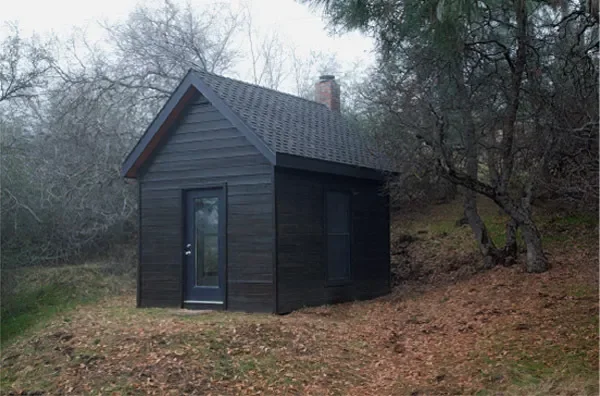
James’ Henry David Thoreau Cabin, constructed July 2007–January 2008.
Several of your films deal with figures we’ve come to associate with true crime, including Ed Gein and Bernadette Protti in Landscape Suicide and Arthur Bremer in American Dreams (Lost and Found). What drew you to the places where these crimes happened? What did you think the landscape might tell you about the violence?
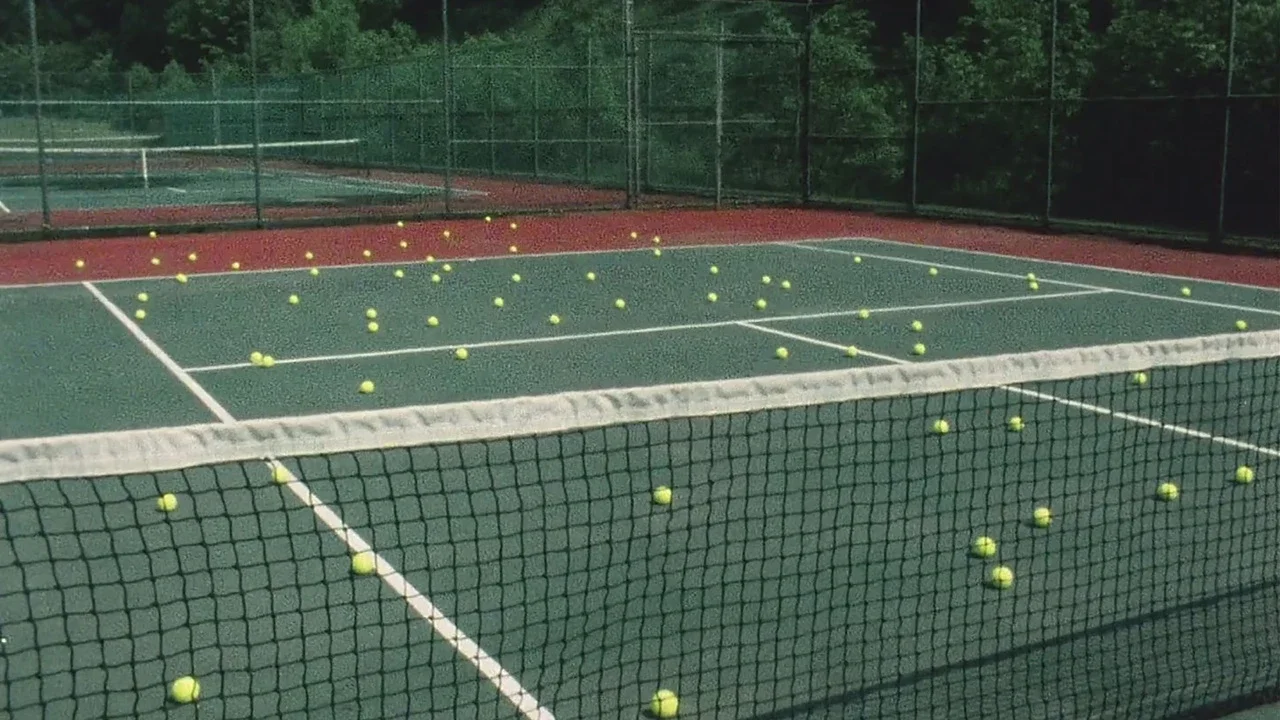
I was never really interested in “true crime,” and especially films that exploited tragedy to create drama. On November 4, 1979, a good friend of mine died in her sleep. She put some white powder up her nose, and it relaxed her breathing into a standstill. The powder turned out to be methadone. I woke up in the morning next to her. She didn’t. To make sense of it, I made Him & Me (1982), followed by American Dreams (Lost and Found), Landscape Suicide, and Used Innocence (1989). Each of these films was an attempt for me to understand tragedy, and it seemed appropriate to look at the surrounding environments. When I visited Plainfield, Wisconsin, in 1985, 30 years after the [Ed] Gein crimes, I could feel a collective guilt which seemed to reside with both the people and the landscape. And the same was true for Orinda, California, where a teenage girl killed a classmate. In the early 1990s, I became interested in the Unabomber because three of the four men who blew up the Army Math Research Center in Madison, Wisconsin, in August of 1970 had been caught. Only Leo Burt was still at large. A few of my friends and I believed Leo might be the Unabomber. Burt has never been caught. Nevertheless, we were wrong, and when Kaczynski was caught, I read his manifesto.
Landscape Suicide. 1986. Dir. James Benning.
What was it about Kaczynski, or about his writing, that held your interest after you read the manifesto and eventually led you to build the second cabin?
When I read the manifesto, I found it both brilliant and crazy. His warnings of what technology will bring were most interesting, and I believe they are proving to be true. Young people are addicted to their phones. And the new data centers will make demands on the environment that could end human life on Earth. The future is scary. But what interested me most was his claim of the over-socialized left. When I did community organizing and voter registration in the late 1960s, I found this to be more than true. My friend Julie Ault was interested in Ted for similar reasons. Together we produced the Two Cabins book. We were both interested in what he had to say about solitude. In 2011, we sent him a letter asking him what he could tell us about his life in the woods. Here’s the first part of his response:
Thank you for your interesting letter dated January 7, 2011. My focus is almost exclusively on a practical problem (to put it succinctly): how to get rid of the techno-industrial system before it gets rid of us. I can’t find much time to spend on such issues as the value of solitude, privacy, or wilderness, except to the extent that these issues are relevant to the practical problem. (They are relevant to a point; teaching people the value of solitude or of wilderness, for example, helps to alienate them from the values of the techno-industrial system.)
Our friend and fellow artist, Danh Vo, took an interest in our interest and bought all of Ted’s journals along with the typewriter that Ted used to write his manifesto. Danh has used some of this material in his own work but was mostly interested in how the journals would affect our practices, Julie’s and mine. Some of the journals were written in a numbered code, some in Spanish. A friend, Tupac Cruz, translated the Spanish, and I decoded Ted’s numbers with the help of instructions that were found in Ted’s cabin when he was arrested. Without the instructions, the code would have been impossible to crack. It took six months to do the decoding, and then I made several films and an installation inspired by the decoding.
Two Cabins, 2011. Dir. James Benning.
You said earlier that you prefer the look of HD digital because it’s “less romantic.” What does that allow you to see, or show, in a landscape that film might not?
Oh, I believe HD digital allows the image to be more truthful by aestheticizing the image less. It renders closer to how the eye sees. Of course, the responsibility of reading an image is with those watching; it’s up to the audience. Watching isn’t an easy job. Those with more experience might see more. But then again, a child might see something I couldn’t begin to imagine. I can learn from them. Truth can hide from me too.
In One Way Boogie Woogie/27 Years Later (2005), you return to places you filmed nearly three decades earlier. What becomes visible to you on a second visit that you couldn’t have seen the first time?
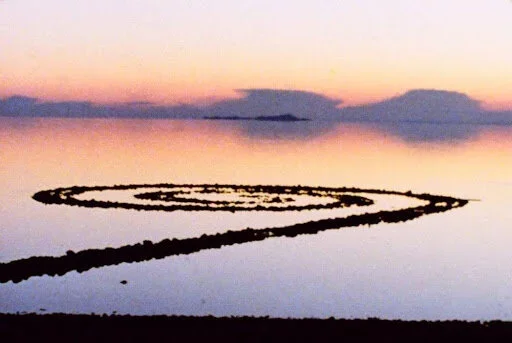
The most noticeable thing is change itself. The first time you visit a place, there is no direct reference to the past. Sure, an aging barn suggests change, but you didn’t have the experience of seeing that barn new. When you return to a place you had seen years before, you have a reference from that first visit. Of course, this also relies on memory, and memory can play its own tricks. But revisiting a place for me reinforces [Robert] Smithson’s ideas on entropy: that all systems break apart and take another form. Eventually, Spiral Jetty will be covered in water or buried in sand. It’s interesting to me that the first day I began filming the jetty, in 2005, it was at the water level when it was built in 1970, and it looked exactly like the famous photos taken when it was brand new. Then, over the next two years, the water level both rose and dropped, so I was able to see it completely underwater and completely out. I was able to film it in many of its states of being.
Casting a Glance, 2007. Dir. James Benning.
I’m struck by how closely your films ask us to listen to the sound of a place. In L. Cohen (2018), Leonard Cohen’s “Love Itself” plays in full over a single static shot. How do you know when an image calls for music?
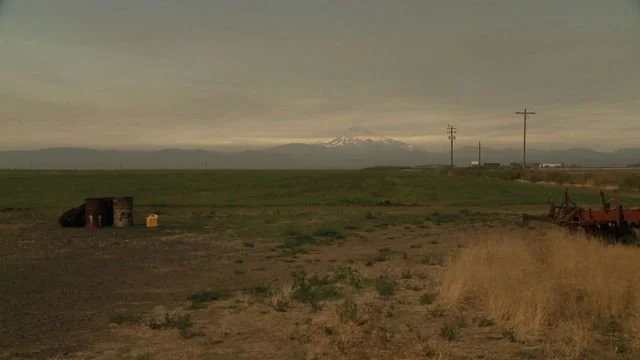
Each time I have used music, it had its own reason. The answer would be different for each occurrence. When I filmed the sun being eclipsed by the moon, it was my first and only time witnessing such an event, and I found it extremely moving. I was all alone on a gravel road; there were cows grazing in a nearby field, and I could hear a crowd cheering from a campground half a mile away. It was day, and then for 2 minutes and 2 seconds it was night, and then day again. The temperature fell; I could feel a slight breeze, and the stars could be seen. A few minutes after it became day again, I thought of Leonard Cohen. This experience seemed to be what Leonard was searching for, and these lyrics of his popped into my head:
The light came through the window
Straight from the sun above
And so inside my little room
There plunged the rays of love
L. Cohen, 2018. Dir. James Benning.
After more than fifty years of filmmaking, what still makes you curious?
This year I have completed two new films, Eden and Hwy 1. Each of them has been inspired by earlier works. Eden relates back to 13 Lakes (2004). It consists of thirty 2½-minute shots of the ocean, all from the same location (Point Mugu), shot over a period of six months. It is also inspired by the B&W photographs of Hiroshi Sugimoto, although my film is in color. The second film is Hwy 1. It has over 600 handheld shots inspired by my film, North on Evers (1992). Even though both films come from earlier works, I have added new elements to make them function differently. In Eden, I read two texts as voice-overs, one taken from my not-yet-published book, A Boy and a Battery, and the other from the last four pages of Jack London’s Martin Eden (1909, Novel). The texts add narrative to a visual film with a highly structural framework. All the images and sounds in Hwy 1 were shot on a small Blackmagic Pocket camera, but some of these sounds and images were appropriations. Even though these two films are inspired by my past, they hopefully add new elements to my filmography. This is what keeps me curious.
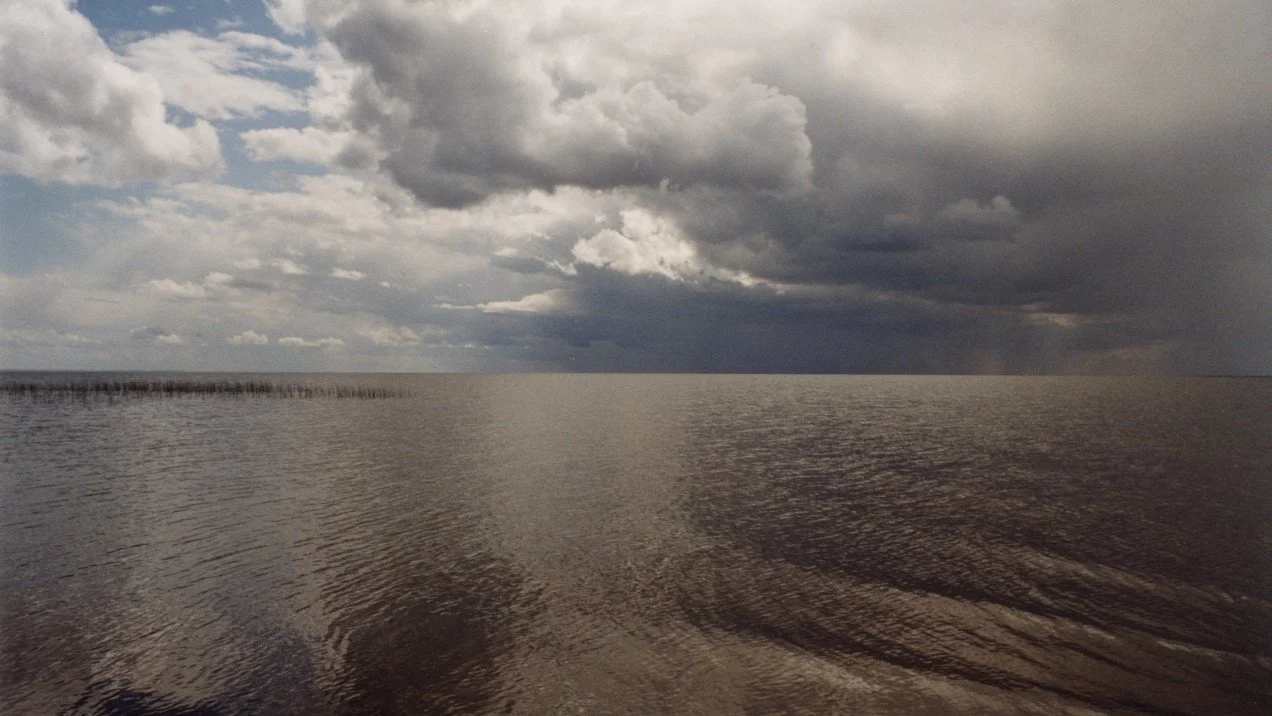
13 Lakes, 2004. Dir. James Benning.